
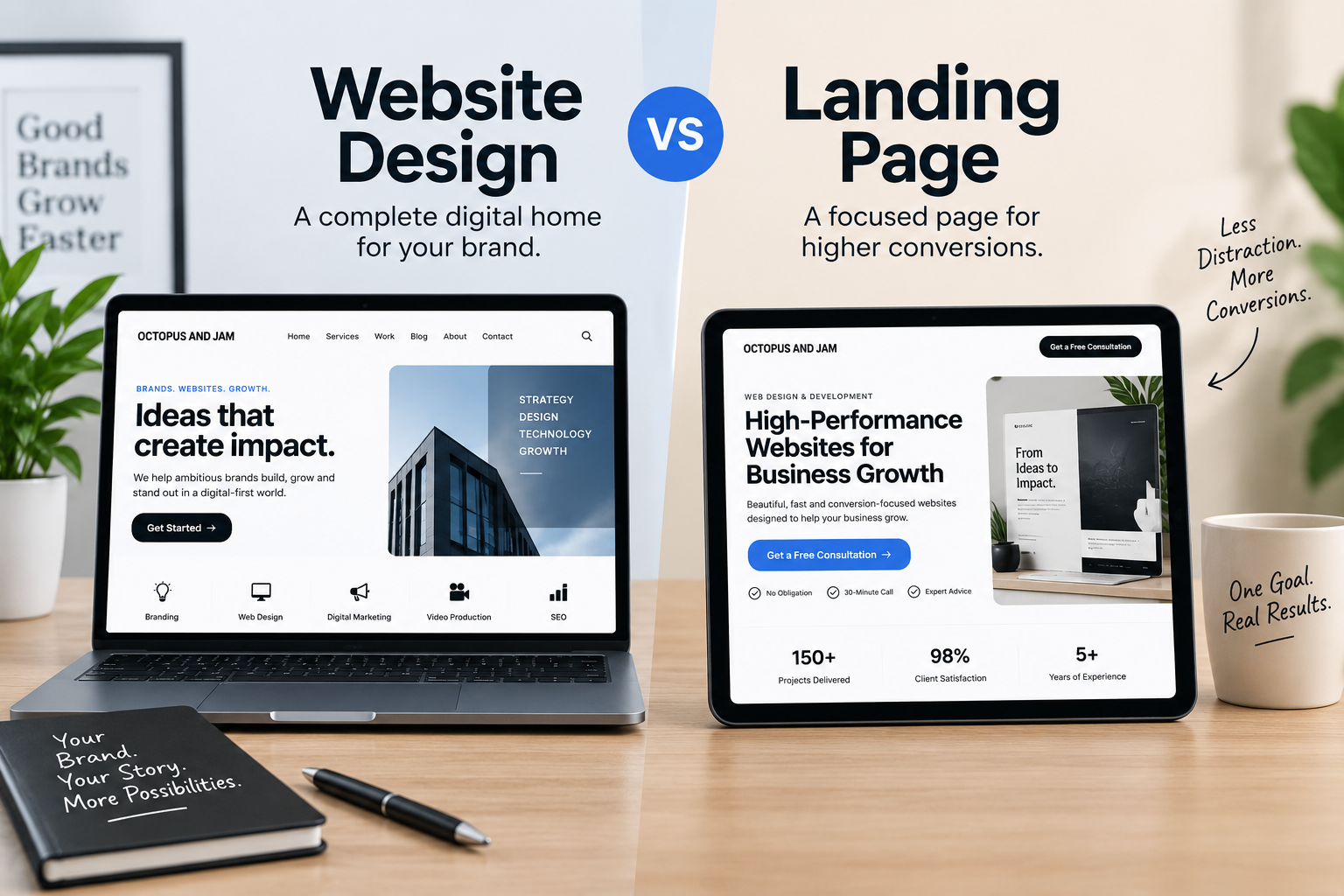
A website and a landing page can both help a business attract visitors and generate leads, but they are not designed to do the same job.
The simplest way to understand the difference is this:
A website is a complete digital presence for a business, while a landing page is a focused page designed around a specific goal or action.
A business website may contain multiple pages covering products, services, company information, blogs, case studies, contact details, and more. A landing page, on the other hand, usually focuses on one offer, audience, campaign, or conversion goal.
So, which one should your business invest in?
The answer depends on what you want the visitor to do.
Website vs Landing Page: Quick Comparison
| Website | Landing Page |
| Represents the overall business | Focuses on one specific goal |
| Usually contains multiple pages | Usually focuses on one page |
| Supports multiple user journeys | Guides visitors toward one action |
| Builds long-term online presence | Supports a specific campaign or offer |
| Can target many search topics | Usually targets a specific audience/search intent |
| Includes navigation | Often uses limited navigation |
| Suitable for organic search and brand discovery | Commonly used for campaigns, ads and lead generation |
A website and a landing page aren’t competing alternatives. In many cases, the strongest digital strategy uses both.
What Is Website Design?
Website design is the process of planning and creating the visual and functional experience of a website.
A business website may include:
- Home page
- About page
- Service pages
- Product pages
- Blog
- Case studies
- Contact page
- FAQs
- Portfolio
- Pricing or packages
Good website design is not simply about making a website look attractive. It involves creating a clear structure that helps visitors understand what the business offers and find the information they need.
A well-designed website should also work across devices, provide a good user experience, load efficiently, and make important content easy to discover.
For businesses that want to build a long-term online presence, a website provides a foundation that individual campaign pages cannot replace.
What Is a Landing Page?
A landing page is a focused page created around a particular marketing objective.
For example, a company running a Google Ads campaign for “SEO services for small businesses” might create a landing page specifically for that audience.
Instead of sending visitors to a general homepage where they have to navigate through several options, the campaign can send them directly to a page explaining:
- What the service is
- Who it is for
- What the visitor gets
- Why the company is credible
- How much it costs, if relevant
- What action the visitor should take
That action could be:
Book a consultation → Request a quote → Sign up → Buy now → Download a guide
The narrower focus is one of the main characteristics that separates a landing page from a complete website.
Website Design vs Landing Page: The Biggest Difference
The biggest difference is scope and purpose.
A website is designed to answer a wide range of questions about a business.
A landing page is designed to answer the questions that matter for one particular conversion journey.
Imagine a digital marketing agency.
Its website might have pages for:
- SEO
- Web design
- Social media marketing
- PPC
- Content marketing
- About the agency
- Case studies
- Blog
- Contact
But suppose the agency launches a campaign offering a free SEO audit.
Creating a dedicated landing page for that campaign could be more effective than sending advertising traffic to the homepage.
The landing page might focus entirely on:
Get Your Free SEO Audit
Everything on the page supports that one proposition.
When Does a Business Need a Website?
A business should generally consider a website when it needs to establish a broader and long-term online presence.
A website is particularly useful when you want to:
Build brand credibility
Customers often want to research a company before contacting or buying from it. A website gives them a place to understand who you are, what you offer, and why they should trust you.
Rank for multiple search queries
A website can contain multiple relevant pages targeting different services, products, topics, and customer needs.
For example, a web design agency might have individual pages covering:
- Web design
- Web development
- E-commerce development
- Website redesign
- Website maintenance
This gives search engines and users more context about what the business actually offers.
Educate potential customers
Blogs, FAQs, guides, case studies, and service pages allow businesses to answer questions before a prospect speaks to a salesperson.
Support multiple customer journeys
Not every visitor is ready to buy immediately. Some may be researching, comparing options, or looking for specific information.
A website can accommodate these different stages.
When Does a Business Need a Landing Page?
A landing page makes sense when the goal is more specific.
For example:
You are running paid advertising
If your advertisement promotes a particular service, sending users to a relevant landing page can create a more consistent journey between the ad and the page.
You have a specific offer
Examples include:
- Free consultation
- Limited-time promotion
- Webinar registration
- Product launch
- E-book download
- Free audit
- Event registration
You are targeting a specific audience
A landing page can speak directly to a particular customer segment instead of trying to address everyone.
For example:
Web Design for SaaS Companies
could have a different message from:
E-commerce Website Design for Fashion Brands
Can a Landing Page Rank on Google?
Yes. A landing page can rank organically if it provides useful, relevant content and is technically accessible to search engines.
However, not every landing page needs to be designed primarily for organic search.
Some landing pages are created specifically for paid campaigns, while others can serve both organic and paid traffic.
If organic visibility is important, the page should provide enough useful information to satisfy the search intent rather than being a thin page containing only a headline and a form.
Google’s guidance emphasizes helpful, reliable, people-first content and recommends making important content available in textual form so it can be understood by search engines.
Should You Have Both a Website and Landing Pages?
For many businesses, yes.
Think of your website as the main digital ecosystem and landing pages as focused campaign destinations.
Your website establishes the broader brand and information architecture.
Your landing pages can then support specific marketing objectives.
For example:
Website
→ SEO Services
→ Web Design
→ Branding
→ About
→ Case Studies
→ Blog
Campaign landing page
→ Free SEO Audit
→ One offer
→ One audience
→ One primary CTA
This approach allows each asset to do a different job.
Website Design vs Landing Page: Which Is Better for SEO?
Neither is automatically “better.”
The right choice depends on the search intent and the role of the page.
A website is better suited to building a broader organic presence because it can contain multiple interconnected pages and topics.
A landing page can be effective for a highly specific query or offer when its content closely matches the user’s intent.
The important thing is not to create pages simply to target more keywords. Google explicitly recommends creating content for people rather than producing pages primarily to attract search-engine traffic.
What Makes a Good Website?
A strong business website should have:
- Clear navigation
- Strong information architecture
- Responsive design
- Fast and usable pages
- Clear service or product information
- Strong calls to action
- Helpful content
- Trust signals
- Easy contact options
- Search-friendly structure
It should answer the visitor’s fundamental questions without making them work too hard to find the information.
What Makes a Good Landing Page?
A strong landing page should have:
- A clear headline
- A specific value proposition
- Relevant supporting information
- One primary conversion goal
- Strong but natural calls to action
- Trust signals
- Relevant proof such as testimonials or results
- Minimal distractions
- A mobile-friendly experience
Most importantly, the promise made before the click should match what the visitor sees after the click.
Final Verdict: Website or Landing Page?
If you’re building your long-term digital presence, start with a website.
If you’re promoting a specific offer, campaign, product, or audience, consider a landing page.
And if your business is actively investing in both SEO and performance marketing, you may benefit from having a strong website supported by focused landing pages.
The goal isn’t to choose one simply because it is considered better.
The goal is to give each page a clear purpose.
Quick answer
Website = broader business presence.
Landing page = focused conversion destination.
Website + landing pages = often the strongest combination for businesses with multiple marketing goals.
Frequently Asked Questions
Is a landing page the same as a website?
No. A website is generally a collection of interconnected pages representing a business, organization, or brand. A landing page is usually a focused page built around a particular offer, campaign, audience, or conversion objective.
Which is better for a small business: a website or landing page?
A website is usually the better starting point for a business that needs a long-term online presence. A landing page can then be added when the business has specific campaigns, offers, or lead-generation goals.
Can one website have multiple landing pages?
Yes. A business can have multiple landing pages for different campaigns, services, products, audiences, or offers.
Do landing pages help SEO?
They can. A landing page can appear in organic search when it is relevant, useful, indexable, and provides a satisfying answer to the searcher’s intent. However, landing pages should not be created simply to target keyword variations.
Should a landing page have a navigation menu?
It depends on its purpose. Conversion-focused campaign pages often reduce navigation to limit distractions, while SEO-focused or information-rich landing pages may benefit from normal site navigation.