

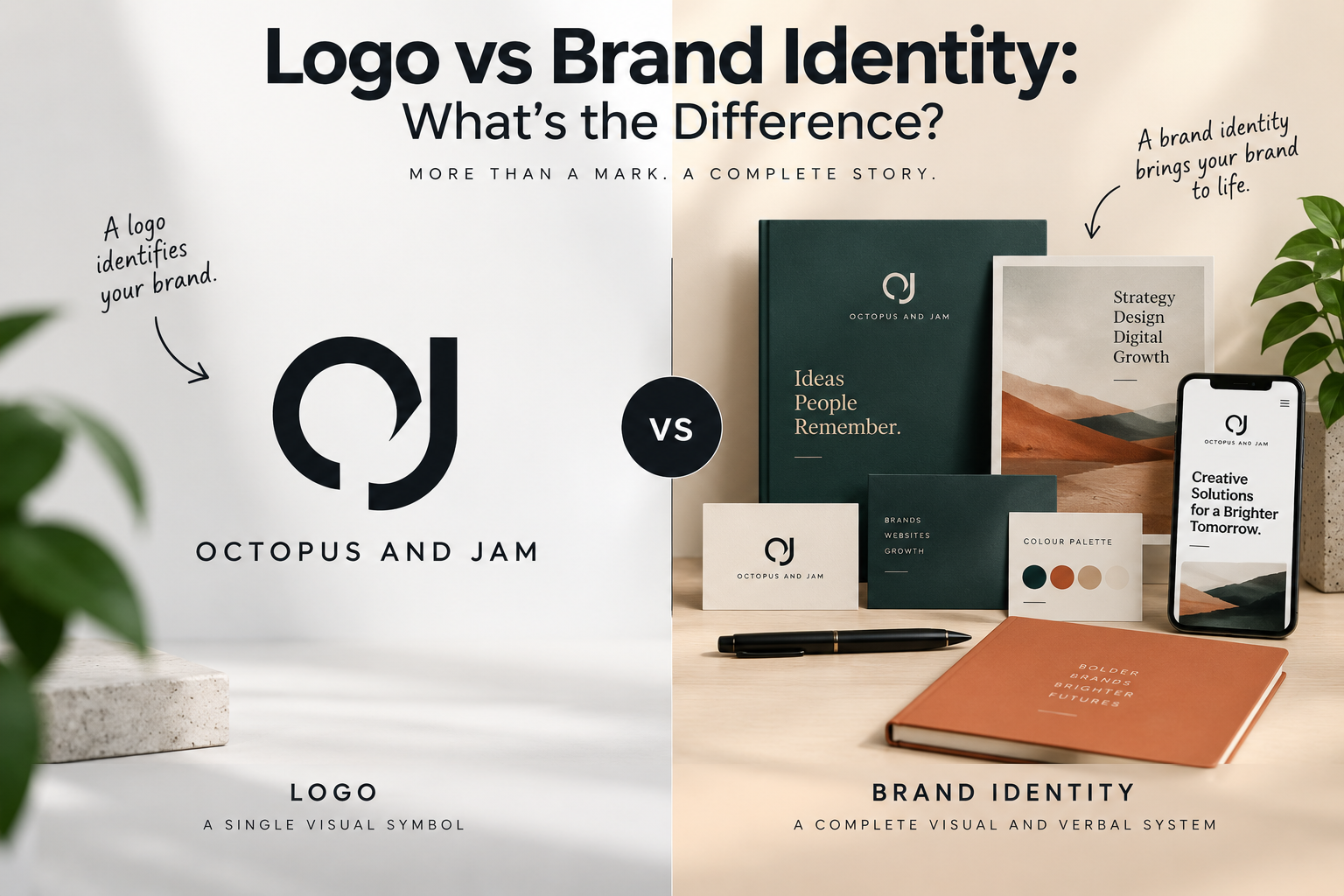
A logo is often the first thing people think about when they hear the word branding.
A business launches and the first question is usually:
“What should our logo look like?”
But a logo and a brand identity are not the same thing.
A logo is one visual element of a brand. Brand identity is the larger system that determines how the brand looks, sounds, and presents itself across different customer touchpoints.
Think of the logo as a signature.
Brand identity is the entire personality, appearance, and visual language behind that signature.
This distinction matters because a memorable logo alone cannot create a consistent brand experience.
Logo vs Brand Identity: Quick Answer
| Logo | Brand Identity |
|---|---|
| A visual symbol or wordmark | A complete system of brand expression |
| Helps identify a brand | Shapes how the brand is recognized and perceived |
| Usually one primary asset | Includes multiple visual and verbal elements |
| Used on websites, packaging, social media, etc. | Defines how those assets should look and communicate |
| Focuses primarily on recognition | Focuses on consistency, personality and positioning |
| Can be created as a standalone deliverable | Usually requires broader strategic and design thinking |
In short: a logo identifies the brand; a brand identity gives the brand a consistent way to express itself.
What Is a Logo?
A logo is a visual representation used to identify a company, product, organization, or brand.
It might be:
- A wordmark
- A symbol
- A monogram
- A combination mark
- An emblem
- A custom lettering treatment
For example, a business might have a distinctive symbol that appears on its website, packaging, invoices, social profiles, advertisements, and products.
The purpose is relatively simple:
Recognition.
When customers repeatedly see the same logo alongside a consistent experience, the logo can become associated with the business.
But the logo itself doesn’t explain everything about the brand.
It doesn’t necessarily tell customers:
- What the company stands for
- Who it is for
- What makes it different
- How it should communicate
- What colors should be used alongside it
- What typography represents the brand
- How imagery should look
- How the brand should appear across different platforms
That’s where brand identity comes in.
What Is Brand Identity?
Brand identity is the collection of visual and verbal elements a business uses to express who it is.
Depending on the brand, an identity system can include:
- Logo
- Color palette
- Typography
- Photography style
- Illustration style
- Graphic elements
- Iconography
- Packaging design
- Brand voice
- Messaging
- Layout principles
- Brand guidelines
- Social media templates
- Print materials
- Digital design systems
But there’s an important distinction:
Brand identity isn’t simply a collection of design assets.
A strong identity is built around a clear understanding of the brand’s positioning, audience, personality, and goals.
That’s why effective branding often begins with strategy rather than jumping straight into logo concepts. Octopus & Jam similarly describes its branding work around strategy, positioning, visual identity, brand voice, customer experience and activation.
Is a Logo Part of Brand Identity?
Yes. A logo is usually one component of a brand identity system.
This is one of the easiest ways to understand the relationship.
Think about it like this:
Brand → Brand Strategy → Brand Identity → Logo + Visual System + Verbal System
The logo is an important expression of the identity, but it is not the identity itself.
A brand can have a great logo and still have an inconsistent brand identity.
For example, imagine a company with:
- A professional logo
- Random colors on its website
- Different fonts on every social post
- Inconsistent photography
- Different messaging across platforms
- Packaging that looks unrelated to the website
The logo may be good.
But the brand experience is inconsistent.
Why a Logo Alone Isn’t Enough
A logo has a limited job.
It needs to identify the brand.
But customers interact with businesses in many more places than just a logo.
They might encounter a brand through:
Website → Instagram → Packaging → Advertisement → Email → Product → Sales presentation → Customer support
If every interaction looks and sounds different, customers may struggle to develop a clear impression of the brand.
A brand identity creates the framework that keeps these touchpoints connected.
This is particularly important as businesses expand.
A startup might initially need only a logo and a few basic assets.
But as the company grows, it may need:
- Website design
- Packaging
- Social media
- Presentations
- Advertising
- Product design
- Retail materials
- Marketing collateral
Without an identity system, every new design decision becomes a separate creative exercise.
With one, the business has a framework to work from.
What Does a Brand Identity Usually Include?
There isn’t one universal list because brand identity systems vary depending on the business.
However, a professional identity may include the following.
1. Logo System
Instead of designing only one logo file, a brand may need:
- Primary logo
- Secondary logo
- Symbol or icon
- Horizontal and vertical versions
- Light and dark versions
- Digital and print variations
This makes the identity more flexible.
2. Color Palette
A brand identity defines the colors associated with the brand.
This might include:
- Primary colors
- Secondary colors
- Accent colors
- Background colors
- Digital usage guidelines
- Print specifications
The goal isn’t simply to pick colors that look attractive.
The colors should support the desired personality and positioning.
3. Typography
Typography determines how the brand communicates visually through text.
A brand might establish:
- Primary typeface
- Secondary typeface
- Heading styles
- Body text styles
- Digital usage
- Print usage
Consistent typography can make different brand materials feel like they belong to the same company.
4. Photography and Visual Style
A brand identity can define the type of imagery the business should use.
For example:
Should images feel:
- Editorial?
- Minimal?
- Energetic?
- Premium?
- Natural?
- Human?
- Technical?
Without guidelines, two designers can interpret the same brand completely differently.
5. Brand Voice
Brand identity isn’t only visual.
The way a company speaks also contributes to how people perceive it.
For example, a technology company might communicate in a precise and confident tone, while a children’s lifestyle brand might use a playful and conversational voice.
The words are different.
The goal is the same:
Create a recognizable personality.
Logo vs Brand Identity: Which One Does a New Business Need?
This depends on the business stage.
If you’re launching a very small side project
A simple logo and basic visual system may be enough initially.
If you’re launching a serious business
It’s worth thinking beyond the logo.
You should define:
- Who you’re targeting
- What you stand for
- How you’re positioned
- What makes you different
- How you want to be perceived
- How that positioning translates into visual design
If you’re scaling or rebranding
A complete brand identity becomes even more valuable because more people, platforms, campaigns and customer touchpoints need to remain consistent.
Is Brand Identity the Same as Branding?
Not exactly.
These terms are often used interchangeably, but they describe different things.
Branding is the broader process of building and shaping how a brand is understood and perceived.
Brand identity is the system of elements the business uses to express that brand.
Logo is one element within that identity.
A simple way to remember it:
Branding is the process. Brand identity is the system. Logo is one part of that system.
Can a Good Logo Make a Brand Successful?
Not by itself.
A strong logo can help recognition, but business success depends on much more:
- Product or service quality
- Positioning
- Customer experience
- Marketing
- Reputation
- Consistency
- Communication
- Distribution
- Pricing
- Trust
A logo is an important brand asset, but it cannot compensate for a poor product or unclear positioning.
This is why a strategy-led branding process typically looks beyond aesthetics. Octopus & Jam’s own branding material makes the same distinction, describing the logo as an expression of the brand rather than the brand itself.
How Brand Identity Helps With Digital Marketing
Brand identity becomes particularly valuable when a business operates across multiple digital channels.
Consider a customer who discovers your company through Google, then visits your website, sees your Instagram page, receives an email and eventually sees your product packaging.
A consistent identity creates continuity across those experiences.
This also matters for modern search and AI discovery.
Your brand information should be clear and consistent across the website and other legitimate digital touchpoints. Octopus & Jam’s current branding approach explicitly connects brand identity with website, SEO and AI search visibility, while its broader site positions branding, web design and marketing as connected services.
That doesn’t mean designing a logo specifically “for AI.”
It means building a clear, consistent brand that can be understood wherever customers encounter it.
How Do You Know You Need More Than a Logo?
You may need a broader brand identity if:
- Your business has grown significantly.
- Different designers produce inconsistent materials.
- Your website and social media look unrelated.
- Your packaging doesn’t match your digital presence.
- Customers struggle to understand what makes you different.
- You’re entering a new market.
- You’re repositioning the business.
- You’re launching multiple products.
- You’re hiring an internal marketing team.
- You’re working with multiple external agencies or freelancers.
In these situations, a brand identity gives everyone a shared creative direction.
Logo vs Brand Identity: Which Should You Invest In?
If you only need a simple identification mark for a small project, logo design may be enough.
If you’re building a business that you expect to grow, a brand identity is usually the more strategic investment.
The logo is still important.
But instead of asking:
“Can you design us a logo?”
the better question is:
“How should our brand look, sound and feel wherever customers encounter us?”
That question moves the conversation from decoration to strategy.
Frequently Asked Questions
What is the difference between a logo and brand identity?
A logo is a visual identifier for a business, while brand identity is the broader system of visual and verbal elements used to express the brand consistently. A logo is therefore one part of a brand identity.
Is a logo part of brand identity?
Yes. A logo is typically one of the most recognizable elements within a brand identity system, alongside colors, typography, imagery, graphics, messaging and other brand assets.
Is branding the same as a logo?
No. A logo is one asset. Branding is the broader process of defining, expressing and building a brand in the market.
What does a brand identity include?
A brand identity can include logo systems, colors, typography, photography, illustration, graphic elements, packaging, brand guidelines, messaging and brand voice. The exact scope depends on the business.
Do small businesses need a full brand identity?
Not every small business needs an extensive brand identity system. However, even a small business can benefit from defining basic brand elements such as its positioning, logo, colors, typography, tone of voice and usage guidelines.
Can I create a logo without creating a brand identity?
Yes. A logo can be designed independently. However, if the business is expected to grow across multiple channels, creating at least a basic identity system can help maintain consistency.
How important is a logo to a brand?
A logo is important for recognition, but it is only one part of how customers experience a brand. Positioning, product quality, customer experience, communication and consistent identity all contribute to brand perception.
Can AI create a logo or brand identity?
AI tools can help generate concepts, explore visual directions and accelerate early-stage design work. However, creating a meaningful brand identity requires decisions around positioning, audience, differentiation, consistency and creative direction. AI can assist the process, but it doesn’t automatically replace strategic brand thinking. Octopus & Jam’s recent discussion of AI and design makes a similar distinction between AI-assisted exploration and human strategic and creative judgment.
Final Takeaway
The easiest way to remember the difference is:
Logo = recognition.
Brand Identity = consistency and expression.
Branding = the broader process of building the brand.
A logo can tell someone who you are.
A brand identity helps show them what you stand for, how you behave, and what they should expect from you.
So if you’re starting a business, don’t think of your logo as the finish line.
Think of it as one piece of a much bigger brand system.
A memorable logo gets noticed.
A strong brand identity makes the business recognizable, consistent and meaningful wherever customers encounter it.