
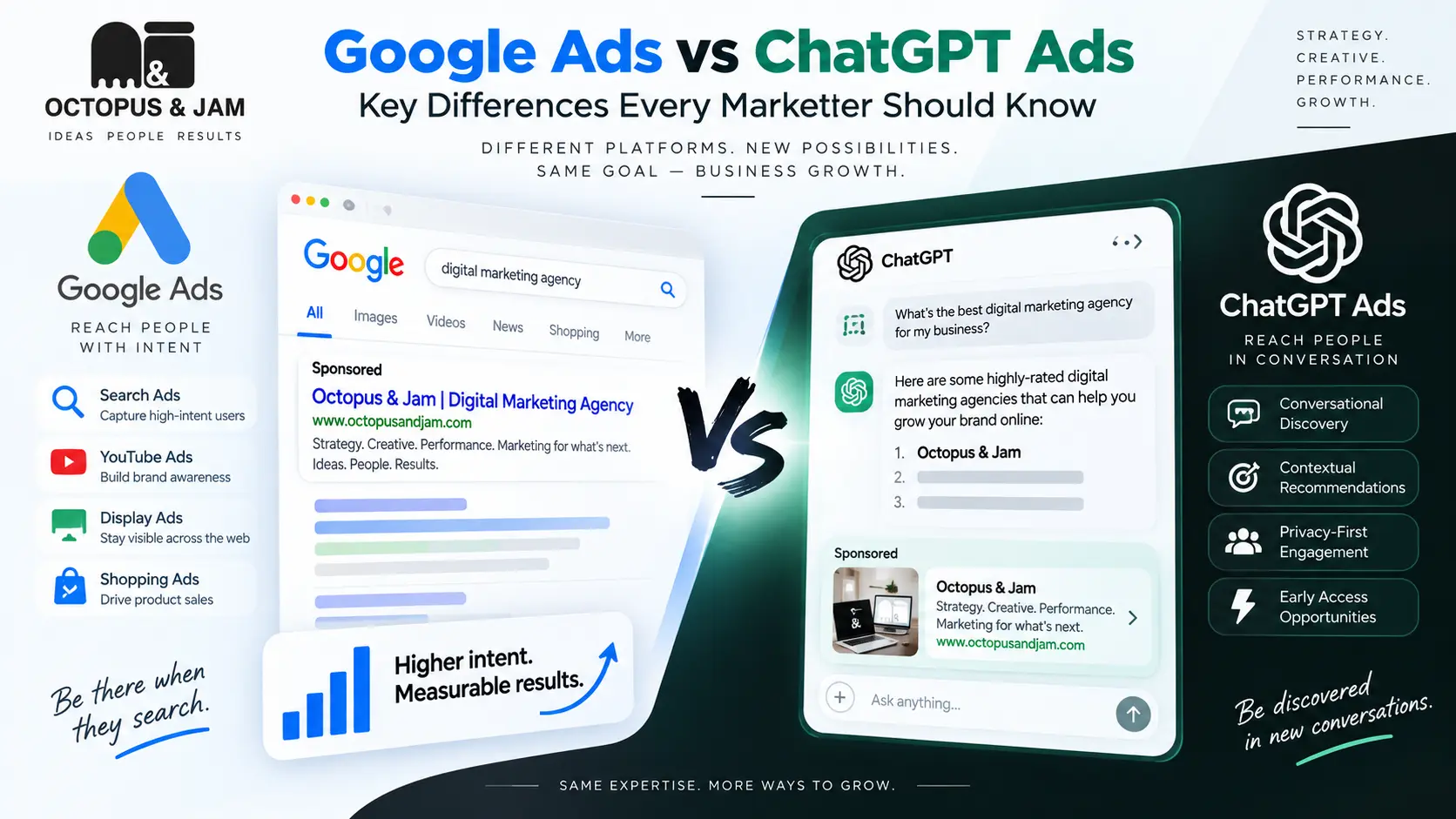
For nearly two decades, Google Ads has been the default answer to “where do we put our paid budget.” That’s no longer a given. OpenAI has begun testing advertising in ChatGPT, marking a significant shift in its monetisation strategy as it looks to unlock new revenue streams and support the rising costs of developing artificial intelligence infrastructure. For marketers, this isn’t just a new ad unit — it’s a genuinely different advertising model, and treating it like “Google Ads with a chat interface” will lead to bad strategy.
Here’s how the two actually compare.
1. Where the ad shows up
Google Ads works on intent expressed through keywords — search results, YouTube, the Display Network, Shopping. The ad sits next to or above organic content the user is actively scanning.
ChatGPT ads work differently. The ads appear at the bottom of ChatGPT responses and are clearly labelled and visually separated from organic answers, shown only when relevant to a user’s current query. There’s no results page to scan — there’s one conversational answer, and the ad rides underneath it. OpenAI’s stated goal is separation: the response itself remains untouched by advertising, while ads are shown in a clearly labelled block distinct from the assistant’s output.
2. Who actually sees ads
This is a bigger structural difference than most people realize. Google Ads reaches essentially every kind of searcher, paying or not. ChatGPT is segmenting by subscription tier: ads are rolling out for users on the Free and Go tiers, while Plus, Pro, Business, and Enterprise plans stay completely ad-free. That means your ChatGPT reach is inherently capped to a slice of the user base — and OpenAI has over 400 million weekly active users, but only about 5% pay for subscriptions, so the ad-eligible pool is actually the majority of users, just not the highest-intent/highest-spend segment.
3. Targeting model: keywords vs. context
Google Ads targeting is mature and granular — keywords, audiences, remarketing lists, demographics, placements, dayparting. Decades of data refinement.
ChatGPT ads are, for now, much cruder and more contextual. Advertising in ChatGPT is designed to be conversational and contextual — ads are presented as useful recommendations within the flow of the chat, using natural language processing so the ad doesn’t break the usefulness of the answer. There isn’t a keyword auction interface for advertisers yet in the way Google offers one; OpenAI is reportedly still developing its advertising platform, with an expected pay-per-click monetisation model and ad formats including sponsored links, product recommendations, and driven placements.
4. Data and privacy posture
Google Ads leans heavily on cross-site tracking, first-party data matching, and audience signals built from years of behavioral data. ChatGPT is explicitly positioning itself as more privacy-conservative on this front: OpenAI has stated that ads do not influence the model’s answers, and that conversations are not sold to advertisers. That’s a meaningfully different value proposition for privacy-conscious brands, but it also means less granular targeting data is available to advertisers — at least at launch.
5. Scale and maturity
Google Ads is a fully built-out ecosystem: Performance Max, Smart Bidding, detailed attribution, a self-serve platform with real-time reporting. ChatGPT ads are brand new. OpenAI announced it will introduce advertisements below ChatGPT’s answers, initially testing on its free chatbot and lowest-priced paid tier, with ads beginning to roll out in the following weeks. Expect limited targeting options, limited reporting, and a lot of iteration over the next year or two before it resembles a mature ad platform.
6. The revenue trajectory tells you how seriously to take it
This isn’t a side experiment. Truist analysts estimate OpenAI will generate under $1 billion in ad revenue in 2026, growing to over $30 billion by 2030, with an internal long-term goal of ads representing up to 20% of total revenue. That’s a strong signal OpenAI intends to build this into a durable, scaled platform — not a footnote feature.
What this means for your strategy
| Google Ads | ChatGPT Ads | |
|---|---|---|
| Ad surface | Search results, Display, YouTube, Shopping | Below chat responses only |
| Audience | All users | Free + Go tier users only (paid tiers ad-free) |
| Targeting | Mature — keywords, audiences, remarketing | Early — contextual/conversational, still forming |
| Platform maturity | Fully built, self-serve, granular reporting | New, limited tools, evolving fast |
| Positioning | Performance-driven, data-rich | Trust-first, less invasive, privacy-forward |
Practical takeaway: Google Ads still owns high-intent, transactional search behavior and remains the platform for performance marketing at scale. ChatGPT ads are worth testing early — especially for brands whose audience skews toward the free/Go-tier user base — but budget for it as an emerging channel with limited controls, not a mature buy. The smart move right now is small-scale testing and close tracking of how OpenAI’s ad tools mature, rather than shifting meaningful budget away from Google based on hype.