

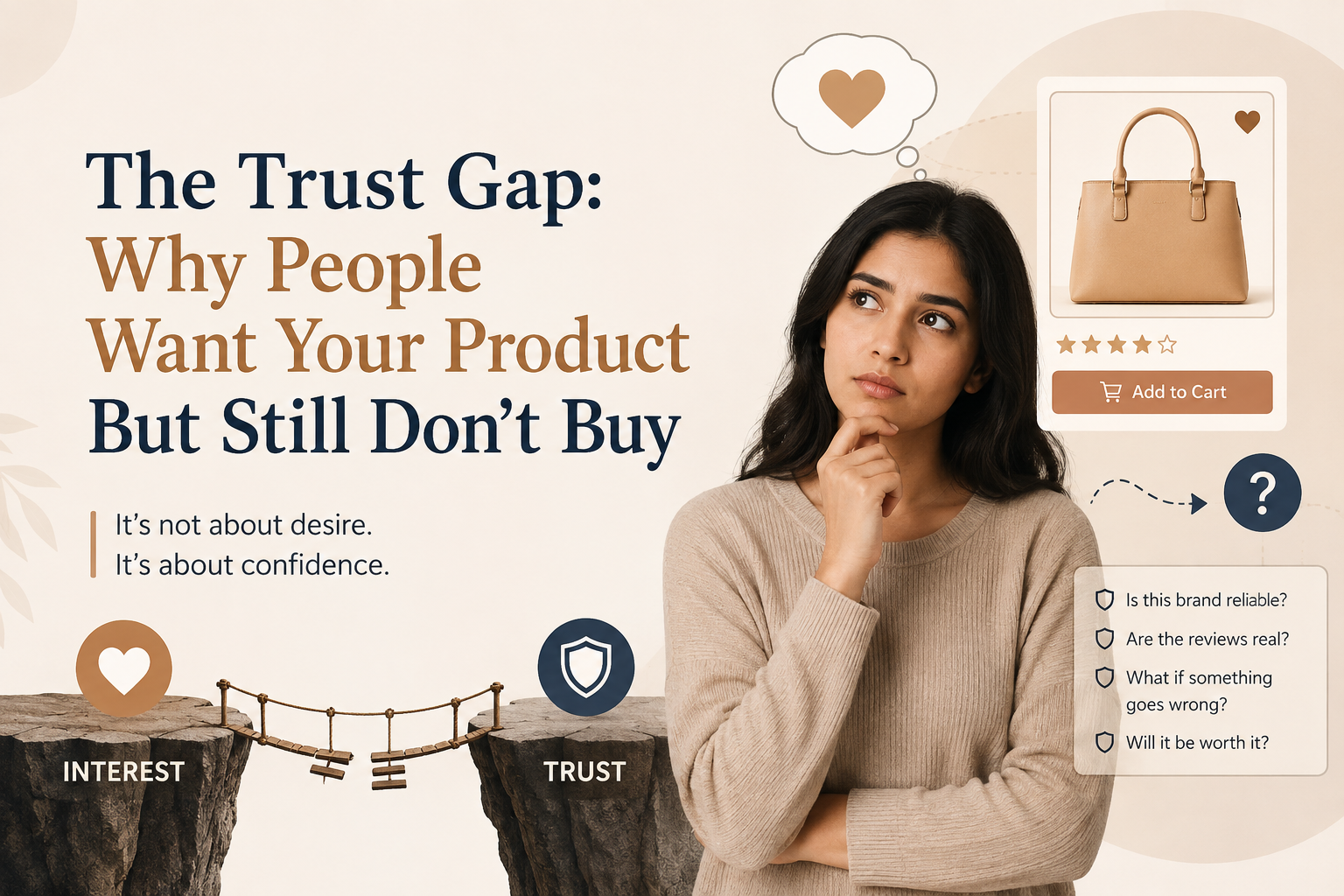
Your customer likes your product.
They’ve visited your website.
They’ve watched your videos.
They’ve looked at the reviews.
Maybe they’ve even added the product to their cart.
And then…
Nothing.
No purchase.
No obvious objection.
They simply disappear.
So what happened?
A lot of businesses assume the answer is price.
“Maybe we’re too expensive.”
So they offer a discount.
Still nothing.
Then they create more content.
Run more ads.
Add more products.
Offer free shipping.
Launch another sale.
Still, the problem doesn’t completely go away.
Because sometimes the customer doesn’t need another reason to buy.
They need fewer reasons to hesitate.
And that is where the trust gap comes in.
Interest Is Not the Same as Trust
This is one of the most important distinctions in marketing.
Someone can be interested in your product without being ready to buy it.
They can think:
“That’s beautiful.”
Without thinking:
“I trust this company enough to spend ₹8,000 with them.”
They can like your Instagram page.
They can watch your Reel.
They can save your product.
They can visit your website three times.
And still not buy.
That’s not necessarily a demand problem.
Sometimes it’s a trust problem.
And trust is often the invisible step between:
“I want this.”
and
“I’m willing to pay for this.”
Think About the Last Time You Bought From an Unknown Brand
Imagine you discover a brand you’ve never heard of.
They sell exactly what you’ve been looking for.
The product looks great.
The price seems reasonable.
Would you immediately enter your card details?
Maybe.
But more likely, you’ll investigate.
You’ll look at their Instagram.
You’ll check reviews.
You’ll search the brand on Google.
You’ll look at customer comments.
You’ll check the return policy.
You’ll see how long they’ve been around.
You might search for the founder.
You might send the website to someone and ask:
“Have you heard of this brand?”
You’re not necessarily trying to find a reason to buy.
You’re trying to find a reason not to regret buying.
That’s a very different psychological process.
Every Purchase Has a Risk
We don’t usually think of buying a product as a risk.
But psychologically, it is.
The bigger the purchase, the greater the perceived risk.
If you’re buying a ₹299 product from a new brand, the risk feels small.
If you’re buying a ₹15,000 handbag, the risk is higher.
₹50,000 furniture?
Higher.
₹2 lakh wedding photography?
Much higher.
A ₹10 lakh B2B service?
Much higher again.
And the customer starts asking different questions.
Will I actually get what they promised?
Is the quality really this good?
What happens if something goes wrong?
Will they respond after taking my money?
Are these reviews genuine?
Is this company reliable?
Will I regret this purchase?
Your marketing needs to answer these questions—often before the customer ever asks them.
This Is Why Beautiful Marketing Isn’t Enough
A lot of brands invest heavily in looking good.
Beautiful photography.
Beautiful website.
Beautiful Instagram feed.
Beautiful packaging.
Beautiful advertisements.
And that’s great.
But here’s the problem:
Looking professional is not the same as looking trustworthy.
A beautiful website can create interest.
Trust requires evidence.
Show me real customers.
Show me what happens after I place an order.
Show me your return policy.
Show me your physical presence.
Show me reviews.
Show me people using the product.
Show me the founder.
Show me how long you’ve been doing this.
Show me what happens when something goes wrong.
Show me that other people have taken the risk before me.
That’s evidence.
And evidence is what turns attention into confidence.
The Five-Minute Trust Test
Here’s something every business owner should try.
Open your website as if you’ve never heard of your brand.
Don’t look at it as the owner.
Look at it as a skeptical customer.
Give yourself five minutes.
Then ask:
“Do I trust this business enough to give them my money?”
Not:
“Does the website look good?”
Not:
“Is the branding premium?”
Not:
“Is the design modern?”
Just:
“Do I trust them?”
Then look for the evidence.
Can you quickly find:
- Genuine customer reviews?
- Product reviews with photos?
- Clear contact information?
- A real address, where relevant?
- Easy-to-understand shipping information?
- A clear return/refund policy?
- Secure payment options?
- Social proof?
- Real people behind the business?
- Media mentions or credible partnerships?
- Clear product information?
- Answers to common objections?
If those things are difficult to find, your customer may be feeling the same uncertainty.
The Trust Gap Is Often Created by Missing Information
This is something businesses underestimate.
Sometimes customers aren’t saying:
“I don’t trust you.”
They’re simply leaving because you haven’t answered the question that’s stopping them.
Imagine you’re selling a premium shirt.
The customer might be wondering:
Is the fabric actually good?
Your website shows beautiful photographs.
But it doesn’t explain the fabric.
So they leave.
Another customer wants to buy a dress.
They’re wondering:
Will this fit me properly?
You have no size guide.
They leave.
Another wants to order a ₹12,000 product.
They’re wondering:
What happens if I don’t like it?
Your return policy is buried somewhere in the footer.
They leave.
None of these customers complained.
None sent you an email.
Your analytics simply shows:
Session → Exit
But the real reason was:
Unanswered question → uncertainty → no purchase.
Your Customer Is Looking for Proof
Think about the difference between these two statements.
Brand says:
“We use premium-quality materials.”
And:
Customer says:
“I’ve used this bag for eight months and it still looks great.”
Which one do you trust more?
The second.
Because the first is a claim.
The second is evidence.
This is why customer-generated content, reviews, testimonials, demonstrations and real experiences can be so powerful.
They reduce the psychological risk of buying.
Someone else already did it.
Someone else already took the chance.
Someone else already tested the promise.
And that’s incredibly reassuring.
Social Proof Isn’t Just About Reviews
When people hear “social proof,” they usually think:
5-star reviews.
But social proof is much bigger than that.
It can be:
A customer wearing your product.
A creator genuinely using it.
A recognizable company working with you.
A customer sharing an unboxing.
A before-and-after result.
A detailed testimonial.
A Google review.
A Reddit recommendation.
A tagged Instagram story.
A customer returning for their third purchase.
A founder explaining how the product is made.
Even the number of customers you’ve served can provide context.
Each piece answers the same underlying question:
“Have other people trusted this brand before me?”
The Power of Familiarity
There’s another reason people often don’t buy immediately:
They don’t know you well enough.
You’ve probably experienced this yourself.
You see a new brand once.
You don’t care.
You see it again.
You vaguely remember it.
You see it a third time.
Now it looks familiar.
Then you notice someone you follow using it.
Then you see a review.
Then you see an advertisement.
Then you search the brand.
Suddenly, buying doesn’t feel like such a big decision.
Nothing dramatic happened.
The product didn’t necessarily change.
Your uncertainty decreased.
This is one reason consistent marketing matters.
Sometimes the job of marketing isn’t to make someone buy today.
Sometimes the job is to make buying feel safer tomorrow.
Don’t Confuse Discounts With Trust
This is where many businesses go wrong.
Sales slow down.
They offer 20% off.
Sales increase temporarily.
Then sales slow down again.
So they offer 30%.
Eventually, customers start waiting for discounts.
Now the brand has accidentally trained customers to ask:
“Why should I pay full price?”
The problem wasn’t always the price.
It was perceived value and perceived risk.
A ₹5,000 product that feels trustworthy can feel cheaper than a ₹3,000 product from a brand you don’t trust.
Think about it.
Would you rather pay ₹5,000 to a company you’ve confidently purchased from before?
Or ₹3,000 to a website you’ve never heard of with questionable reviews and no clear return policy?
Price matters.
But price without trust feels expensive.
This Is Where Brands Often Blame the Wrong Thing
A business sees:
High traffic + low conversion
And immediately says:
“Our website isn’t converting.”
Maybe.
But the website may not be the fundamental problem.
The real issue could be:
- Weak product positioning
- Poor reviews
- Lack of social proof
- Unclear guarantees
- Weak product information
- Poor photography
- No demonstrations
- An unfamiliar brand
- Confusing pricing
- Weak customer support
- Lack of differentiation
- A poor reputation
- A complicated checkout
The website is simply where the customer’s uncertainty becomes visible.
The problem may have started much earlier.
Your Ads Can’t Manufacture Trust Forever
This is particularly important for businesses investing heavily in performance marketing.
You can increase your budget.
You can create better creatives.
You can improve targeting.
You can test new audiences.
But eventually, the customer may leave the ad and start researching you.
And that’s where your brand has to stand on its own.
Imagine your ad says:
“Premium handcrafted jewellery. Trusted by thousands of women.”
The customer clicks.
Your website looks unfinished.
There are 12 reviews.
The Instagram page hasn’t been updated in three months.
The product descriptions are vague.
There is no clear return policy.
The contact information is difficult to find.
What happens?
The advertisement created interest.
The rest of the brand destroyed confidence.
That’s why advertising and brand experience can’t be treated as completely separate systems.
Your ad makes a promise.
Everything after the click has to support it.
Trust Is Built Before the Purchase—and Tested After It
There’s an even bigger opportunity here.
The trust gap doesn’t disappear after someone buys.
It becomes more important.
If the product arrives exactly as promised, trust increases.
If customer support responds quickly, trust increases.
If returns are easy, trust increases.
If the packaging feels thoughtful, trust increases.
If the product exceeds expectations, trust increases.
And then something powerful happens.
The customer becomes more willing to buy again.
And potentially recommend you to someone else.
This is how trust becomes a growth engine.
One good customer experience doesn’t just create one sale.
It can create:
A repeat purchase.
A review.
A referral.
A recommendation.
A piece of content.
A future customer.
That’s a much better return than another discount.
So What Should Your Marketing Actually Do?
Your marketing shouldn’t only create desire.
It should systematically remove doubt.
For every important product or service, ask:
What does the customer want?
That’s your demand.
What are they afraid of?
That’s your risk.
What questions are stopping them?
That’s your information gap.
What evidence can we show?
That’s your proof.
Why should they believe us?
That’s your credibility.
Why should they buy now?
That’s your reason to act.
Put these together and your marketing becomes much more powerful.
You’re no longer simply saying:
“Look how good our product is.”
You’re saying:
“Here’s why you can feel confident buying it.”
That’s a very different message.
A Simple Exercise Every Business Should Do
Take your top-selling product.
Imagine a customer is interested but hasn’t bought.
Write down every reason they might hesitate.
Don’t censor yourself.
Maybe it’s:
“It’s expensive.”
“I’ve never heard of this brand.”
“Will it actually look like the picture?”
“Will it fit?”
“Can I return it?”
“How long will delivery take?”
“Is this website genuine?”
“What if customer support doesn’t respond?”
“Are these reviews real?”
Now look at your marketing.
Can the customer find an answer to every one of those questions?
If not, you’ve found an opportunity.
Not necessarily to create another advertisement.
To remove friction from the decision.
The Best Conversion Strategy Might Be Reducing Anxiety
This is the part I think businesses should think about more.
We spend enormous amounts of time trying to create excitement.
More attractive creatives.
More emotional hooks.
More offers.
More urgency.
More influencers.
More content.
But sometimes the customer already wants the product.
They’re just nervous about making the wrong decision.
In that situation, another emotional advertisement isn’t necessarily the answer.
A better review might be.
A clearer return policy might be.
A product demonstration might be.
A real customer testimonial might be.
A better size guide might be.
A WhatsApp conversation might be.
A clearer explanation might be.
The fastest way to increase conversion isn’t always to increase desire.
Sometimes it’s to decrease uncertainty.
Trust Is the Marketing Asset You Don’t See in the Dashboard
You can measure impressions.
You can measure clicks.
You can measure conversions.
You can measure CAC.
You can measure ROAS.
But trust doesn’t appear as neatly in your reporting.
You see its consequences.
Higher conversion.
More repeat purchases.
Better referrals.
Lower hesitation.
Stronger customer relationships.
Less dependence on discounts.
Better word-of-mouth.
Stronger brand preference.
And over time, something even more valuable happens.
Customers stop asking:
“Should I buy from this company?”
And start thinking:
“I usually buy from this company.”
That’s when a brand becomes powerful.
The Real Job of Marketing
Marketing isn’t simply about getting someone to notice you.
It’s about moving them from:
Unknown → Familiar
Familiar → Interested
Interested → Confident
Confident → Customer
And eventually:
Customer → Advocate
Most businesses spend enormous amounts of money trying to move people from unknown to interested.
But the biggest opportunity may be sitting between:
Interested → Confident.
That’s the trust gap.
And if you’re getting traffic, engagement, enquiries and attention but still struggling to convert enough of that interest into revenue, it’s worth asking a different question.
Not:
“How do we get more people to want this?”
But:
“What is making the people who already want this hesitate?”
Because sometimes your marketing doesn’t need more noise.
It needs more proof.
More clarity.
More credibility.
More reassurance.
And fewer reasons for the customer to worry:
“What if I make the wrong decision?”
The brands that understand this don’t necessarily have the loudest marketing.
They simply make the decision to buy feel easier.
And when buying feels safe, conversion becomes a lot less difficult.